

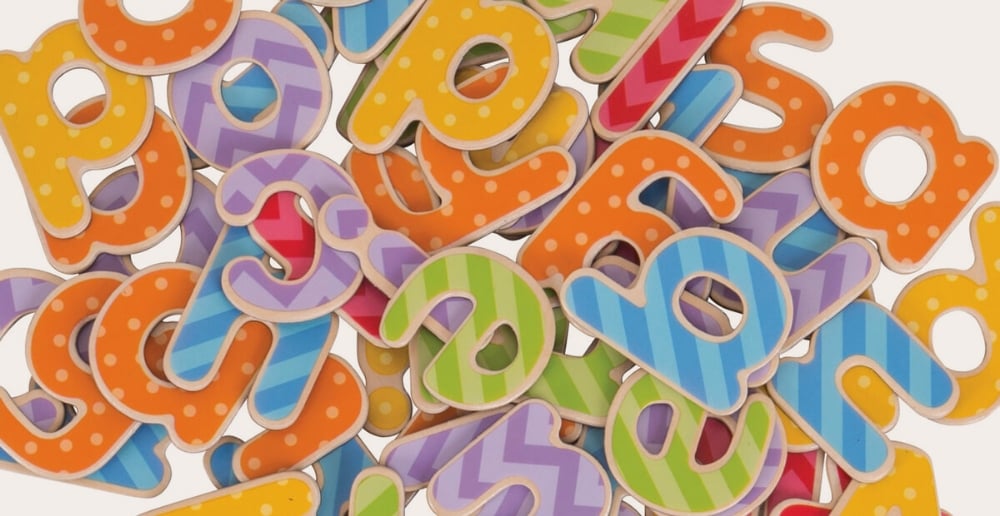
Many children start noticing letters from around the age of two and begin recognising some letters between three and four. In England, more structured learning about letters and their sounds usually begins in Reception, when children are four to five.
There isn't, however, a particular age when a child should know the alphabet. Some children are fascinated by letters early on, while others are much more interested in stories, pictures and conversation. All of these can support early literacy, so it's better to follow your child's curiosity than worry about reaching a particular milestone by a certain birthday.
When do children start learning letters?
Children are becoming familiar with written language long before they can name individual letters. They see words in books, on food packets, road signs and shop fronts, hear alphabet songs and rhymes, and begin to understand that the marks they see on a page have meaning.
Around 18 months to 2 years, it's mostly about this kind of everyday exposure. Reading together, singing songs and talking about what you see helps children become familiar with words and sounds. There's no need to formally teach letters at this stage.
Between 2 and 3, some children start noticing familiar letters, particularly the first letter of their own name. They might spot the same letter elsewhere, ask what something says or pretend to write when they see an adult making a shopping list.
Between 3 and 4, interest in individual letters often grows. Children may recognise and name some letters, notice the difference between upper and lowercase versions and begin connecting a few letters with their sounds.
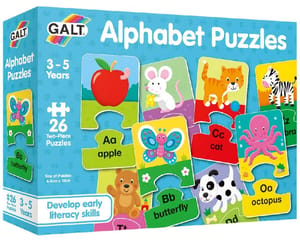
Simple matching activities can be useful at this stage. Our Alphabet Puzzles, for ages 3 to 5, include 26 colourful two-piece puzzles that pair upper and lowercase letters with pictures and words. Children can start with letters they already recognise rather than feeling they need to work through A to Z.
Between 4 and 5, children in Reception in England begin more structured learning about letters and sounds through phonics. The Government's Development Matters early years guidance includes learning letter-sound relationships, blending sounds to read words and forming upper and lowercase letters.
This is an important distinction: knowing the alphabet and learning to read aren't quite the same thing. Being able to recite A to Z is useful, but phonics helps children understand the sounds that written letters represent and how those sounds can be put together to read words.
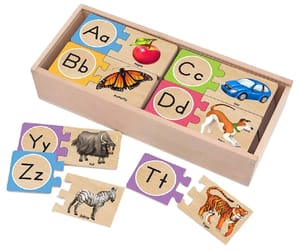
For children aged 4+, Wooden Alphabet Puzzles offer another way to explore letter recognition, matching upper and lowercase letters with familiar pictures.
These ages are a rough guide, not a checklist. Children develop at different rates, and learning the alphabet earlier isn't a race or a guarantee that reading will come more easily.
How can I tell if my child is ready to learn the alphabet?
Your child's behaviour can tell you more than their age.
Perhaps they point out letters on signs, ask what a word says or recognise their own name when they see it written down. They might enjoy scribbling and pretending to write, ask for the same book again and again or suddenly become fascinated by a particular letter.
These little moments of curiosity are good opportunities to talk about letters naturally. If they spot the first letter of their name on a sign, for example, you could see if you can find another one together.
And if they're simply not interested yet, there's no need to push it. Reading stories, singing rhymes, talking and playing with language are all valuable. Letters can wait until they begin to capture your child's attention.
What are some fun ways to help a child learn the alphabet?
Alphabet activities don't have to involve sitting down and reciting A to Z. Letters can be matched, moved, hunted for, talked about and even acted out. Trying different approaches can also help you discover what your child enjoys most.
Try letters they can touch and move
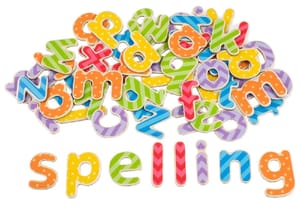
Physical letters give children the freedom to pick them up, compare their shapes and move them around. Magnetic Letters - Lowercase, suitable from age 3, can be used on a magnetic board, fridge door or other suitable magnetic surface.
A child's own name is an easy place to begin. Find its first letter together, hunt for another copy or pick out the letters needed to make their name. As they become more confident, you can use the same letters to explore simple words.
Turn letter recognition into a game
If your child enjoys games, make letters part of one rather than turning them into a lesson.
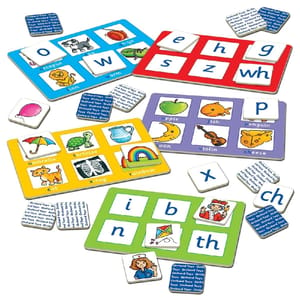
Alphabet Lotto, suitable from age 3, has four different ways to play, including matching pictures to pictures, letters to pictures and letters to letters. That means you can choose a simple version to begin with and introduce different ways to play as letter recognition develops.
You can create your own games too. Choose a letter and see who can spot it first on a cereal packet, find three things beginning with the same sound or hunt for letters while you're out and about.
Get up and move
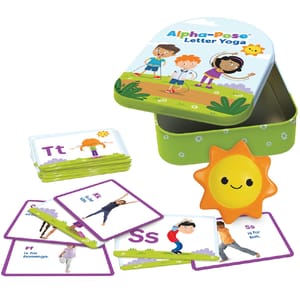
Some children learn best when they can move at the same time. Alpha-Pose Letter Yoga, for ages 4+, uses 26 double-sided cards to connect letters and words with child-friendly yoga poses.
It's a fun alternative to tabletop activities and a reminder that early learning doesn't always need to happen sitting in a chair.
How can we practise letters in everyday life?
You don't need a special alphabet activity every day. Some of the best opportunities are already part of your normal routine.
Look for the first letter of your child's name while you're out for a walk. Point out familiar letters on food packaging or shop signs. Let them help "write" the shopping list, even if their contribution is mostly scribbles. At mealtimes, choose a letter sound and see how many foods, animals or names you can think of that begin with it.
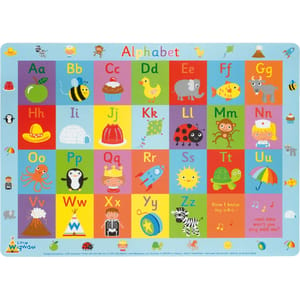
An Alphabet Placemat is another simple way to keep letters visible during an everyday part of the day, with upper and lowercase letters and colourful illustrations to spot and talk about together.
You don't need to turn every moment into a learning opportunity. The idea is simply to let children see that letters and words are all around them.
So, what age should a child know the alphabet?
There's no single age by which every child should know the whole alphabet. Children often start noticing letters as toddlers, recognise more of them during the preschool years and begin structured phonics teaching when they reach Reception.
If your child is interested, encourage that curiosity. Read together, talk about the letters and words you come across and try simple games that suit the way they like to play. If they're not interested yet, there's no need to turn the alphabet into something they feel they have to learn.
Knowing A to Z is just one small part of learning to read and write. Give children plenty of opportunities to enjoy books, words, sounds and letters, and let their confidence grow at their own pace.
Looking for more playful ways to explore letters and words? Browse our full range of English learning toys.
